
Focus areas that actually pay off (and how LeanLens chooses them)
Need a focused next step? See Muscle Balance and Physique Score for practical companion workflows.
Most people don’t need a new program. They need a small, focused upgrade that they can actually stick to.
That’s what “focus areas” are for.
What a focus area means
A focus area is a place where a little extra work can create a noticeable payoff.
LeanLens surfaces these so you don’t have to guess (or rebuild your plan every Monday).
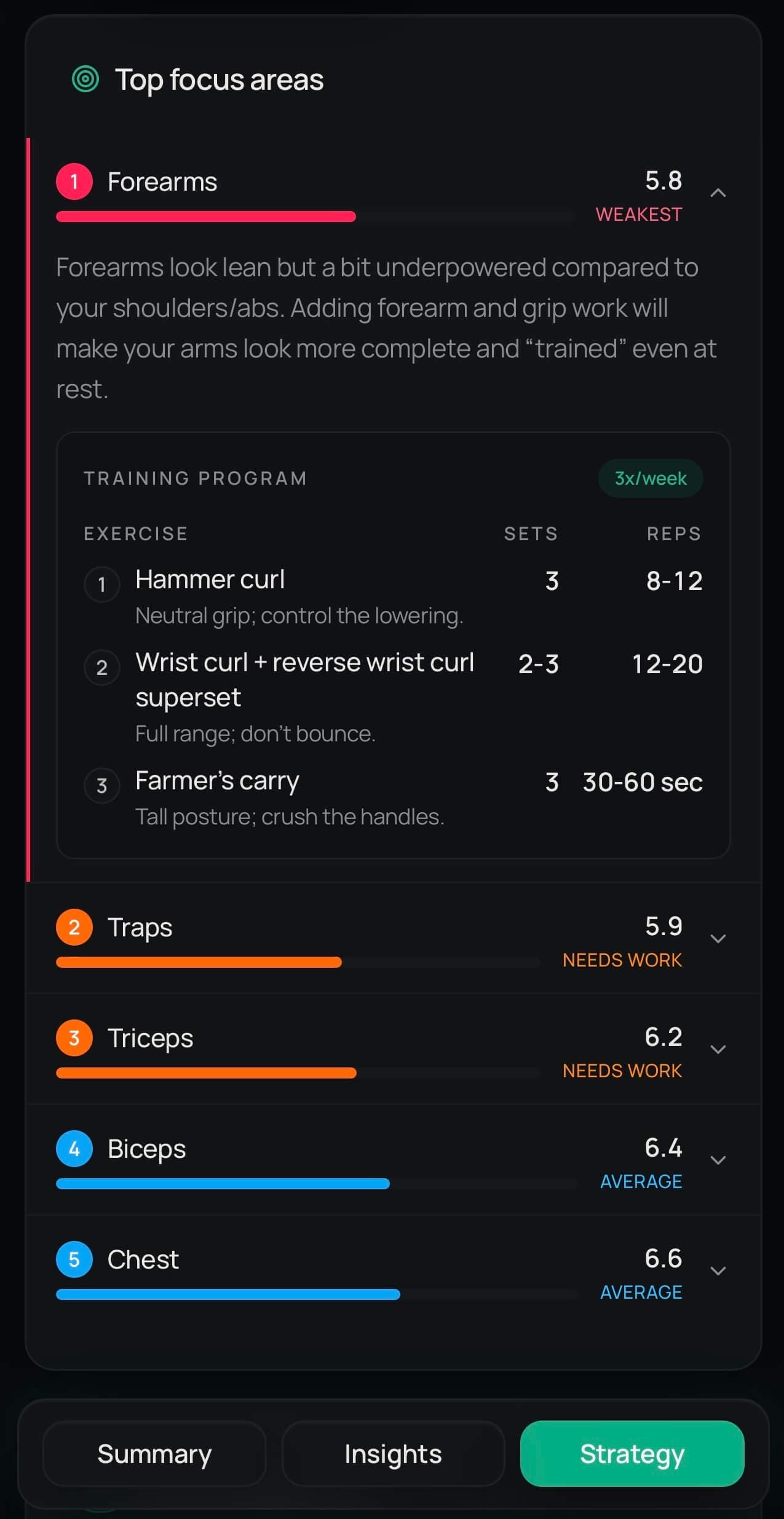
The 80/20 method (simple, boring, effective)
Pick one focus area for 4–6 weeks and do this:
- Add 2–4 hard sets per week for that area
- Keep the rest of your program the same
- Re-check in after you’ve accumulated weeks, not days
Example:
- Focus: shoulders
- Add: 2 sets lateral raises + 2 sets rear delts per week
That’s it. No need to “start over.”
Focus work should support your training, not replace it. If you’re losing consistency, you added too much.
How focus areas work in real life
A focus area is not a complete program rewrite. It is a precision upgrade.
Most plateaus happen because people add volume everywhere. That creates fatigue, weaker execution, and confusion about what is actually driving results.
A better strategy is narrow and repeatable:
- keep your core split stable
- add targeted work to one lagging area
- keep progression measurable for 4-6 weeks
This creates cleaner feedback. You can tell whether the extra effort helped because everything else stayed mostly constant.
Practical framework: 6-week focus cycle
| Week | Priority | What to track | | ---- | --------------------------------------------- | ------------------------------------- | | 1 | Set baseline volume and exercise choices | Session completion + perceived effort | | 2-3 | Progressive overload on focus area | Reps, load, and execution quality | | 4 | Maintain consistency under normal life stress | Adherence score + recovery quality | | 5-6 | Evaluate response and decide next focus | Snapshot trend + performance trend |
Simple rule: if adherence was low, improve adherence first. If adherence was good and response was weak, adjust exercise selection or weekly set count.
Example scenario: lagging shoulders without program chaos
Let’s say your shoulders consistently show up as a high-payoff focus area.
Instead of replacing your split, you choose two additions:
- 2 sets lateral raises twice per week
- 2 sets rear-delt rows once per week
You keep compounds and nutrition structure unchanged for six weeks. At the end, you review:
- snapshot trend
- shoulder exercise progression
- fatigue and recovery quality
If all three look acceptable, you keep the improvement and pick the next bottleneck. If recovery drops hard, you reduce one accessory block and reassess.
Common mistakes with focus work
- Picking three focus areas at once.
- Changing exercise selection every week.
- Doubling volume without removing low-value fatigue.
- Ignoring sleep and recovery while adding workload.
- Ending the cycle before enough data exists.
Focus areas only work when consistency is higher than novelty.
What to do this week
- Pick one focus area only.
- Add 2-4 high-quality sets per week for 4-6 weeks.
- Keep every other major variable stable.
- Log execution quality after each session.
- Review trend data before making the next change.
This is how you build a physique strategically, not emotionally.
Limitations
Focus areas are guidance, not gospel. They’re most useful when:
- your photos are consistent
- your training is consistent
- you track over time instead of chasing daily changes
They also do not replace individualized medical or coaching care where needed.
Get a confidence-aware range and practical next steps from a single photo.
Photos not stored by LeanLens after processing.
Start My Check-In