
Build a repeatable progress record
Pair your measurement log with photos taken from consistent angles.
There is no single current worldwide average thigh size. A traceable US reference is NHANES 2003–2006: men age 20 and older averaged 53.8 cm (21.2 inches), while women averaged 52.9 cm (20.8 inches) at the mid-thigh measurement site.
Those observations are now historical. The newer NHANES August 2021–August 2023 reference publication reports waist, hip and upper-arm circumference but not a comparable thigh-circumference table. Presenting the older numbers as a new 2026 average would hide an important limitation.
Historical mid-thigh circumference: US NHANES 2003–2006, tables 40–41
| Age | Men: cm / inches | Women: cm / inches |
|---|---|---|
| 20 and older | 53.8 / 21.2 | 52.9 / 20.8 |
| 20–29 | 55.1 / 21.7 | 52.9 / 20.8 |
| 30–39 | 55.1 / 21.7 | 54.2 / 21.3 |
| 40–49 | 55.0 / 21.7 | 54.4 / 21.4 |
| 50–59 | 53.2 / 20.9 | 53.2 / 20.9 |
| 60–69 | 51.9 / 20.4 | 52.2 / 20.6 |
| 70–79 | 50.0 / 19.7 | 49.6 / 19.5 |
| 80 and older | 46.6 / 18.3 | 47.5 / 18.7 |
Read the historical table correctly
The reference includes 4,255 examined men and 4,065 examined women age 20 and older. Pregnant women were excluded. These are survey-weighted US population means, not an athlete sample or a recommendation for your body.
Centimeters are reproduced from the CDC tables; inches are calculated using 1 inch = 2.54 cm and rounded to one decimal. Age groups contain different people, so the table is not a longitudinal forecast of how your legs will change.
The age and geography limits matter in every language. Translating this article does not turn US 2003–2006 data into a present-day average for Portugal, Brazil, Germany or any other country.
Mid-thigh and widest thigh are different measurements
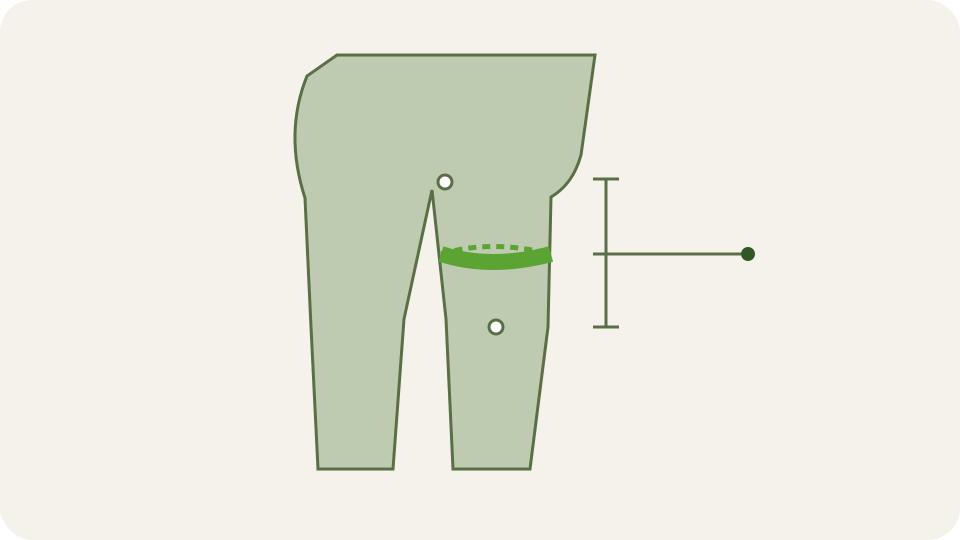
The historical NHANES protocol identifies a midpoint along the upper leg, between the groin crease and a landmark just above the kneecap. That is not necessarily the thickest part of your thigh, nor an arbitrary distance below your shorts.
A tape placed higher on the same leg can give a different reading without any tissue change. If your existing log uses the widest point, keep that series consistent but do not compare it directly with the midpoint table. Write down the site and which leg you measured.
Build a repeatable progress record
Pair your measurement log with photos taken from consistent angles.
How to make a repeatable thigh measurement
Use a flexible, nonstretch tape and locate your chosen site before wrapping it around the leg. Keep the tape level at that site and avoid compressing the skin. Relax the measured leg rather than deliberately flexing it.
For a comparison with the NHANES reference, follow the linked measurement manual’s anatomical midpoint procedure. A home approximation is useful for your own trend but is not automatically equivalent to an examiner’s standardized measurement.
- Choose and record the right or left leg.
- Mark the same anatomical site each time.
- Keep the tape level and the muscle relaxed.
- Record the date, site and reading; repeat if placement or tension changed.
Are 20-, 22- or 24-inch thighs normal?
Those circumferences are 50.8, 55.9 and 61.0 cm, respectively. A number alone cannot label a leg healthy, unhealthy or ideally muscular. Height, tissue composition, measurement site and population differences all affect interpretation.
The tape includes muscle, fat, bone and other tissues. Large thighs are not proof of more quadriceps muscle, and a smaller thigh during weight loss is not proof that all the lost circumference was muscle. Avoid “ideal thigh size” formulas that turn an unsupported proportion into a health rule.
Use thigh changes to ask a better progress question
Compare repeat measurements with your training log, body-weight trend and progress photos. Keep camera height, pose and lighting similar. A front photo alone may hide changes that are clearer from the side, so use consistent views.
For example, a change from 56 to 55 cm is a 1 cm reduction at that recorded site. It cannot tell you exactly how much muscle or fat changed. If your goal is body recomposition, interpret that change alongside strength, waist measurements and the longer trend.
The body measurement guide helps organize consistent checks. Our body visualizer is an illustration of entered proportions, not a way to measure thigh circumference from a photo.
Limits and safety
Population averages describe a sample; they are not ideal sizes, diagnoses or personal targets. This article is educational fitness information, not medical advice.
FAQ
What is the average thigh size for men and women?
The historical NHANES 2003–2006 US adult means were 53.8 cm (21.2 inches) for men and 52.9 cm (20.8 inches) for women at mid-thigh. They are not current global averages or target sizes.
Where should I measure my thigh?
Use a documented site consistently. This article’s reference table uses an anatomical upper-leg midpoint, not the widest part. For your own widest-thigh log, keep that method separate from midpoint comparisons.
Does the latest CDC report have thigh averages?
The NHANES 2021–2023 anthropometric reference report does not include comparable thigh-circumference tables. The thigh values shown here come from the clearly dated 2003–2006 report.
Does a smaller thigh mean muscle loss?
Not necessarily. Tape circumference cannot separate muscle, fat and other changes. Review repeated measurements alongside training performance, weight and consistent photos rather than diagnosing muscle loss from one reading.